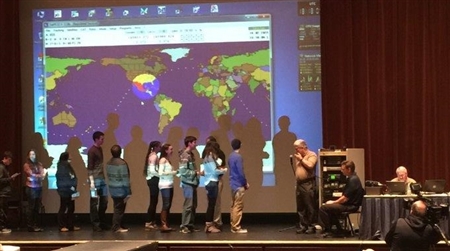
Three-hundred and fifty students sat in complete silence in the auditorium at Council Rock High School South just outside of Philadelphia, Pennsylvania. The only sound heard was the constant static from the speakers hanging overhead. On stage sat three members of the K3DN.org amateur radio (ham radio) operating club, along with a science and astronomy teacher and 10 students anxiously awaiting a voice to cut through the crackling static.
 “NA1-ISS, this is K3DN, can you hear me,” said one of the ham radio operators into the microphone.
Nothing but static.
“NA1-ISS, this is K3DN, do you read me,” the man repeated again.
Then, suddenly and faintly, a garbled voice could be heard.
“K3DN, this is NA1-ISS, I can hear you,” said Italian astronaut Samantha Cristoforetti, speaking from the International Space Station (ISS), traveling 220 miles above the auditorium and more than 17,000 miles per hour through space.
As soon as Samantha’s voice came through the speakers, you could see all of the high school students in the auditorium collectively lean forward in their chairs, but TIer Joe Horanzy couldn’t look up from his work area. The senior embedded processor field applications engineer and ham radio enthusiast sat busily at the controls of the radio system he built with two of his amateur radio colleagues, constantly switching dials and making adjustments to keep the space station tuned in for the eight minutes it was within range of his antennas.
“My heartbeat felt like I was running on a treadmill,” Joe said as he detailed the thrill of connecting with astronauts flying through space.
This momentous occasion, captured by local media (see the stories from CBS Philadelphia the Bucks County Courier Times), took weeks of planning and more than 150 volunteer hours by Joe and his ham radio operating friends.
Council Rock High School South has a unique relationship with the U.S. National Aeronautics and Space Administration (NASA). The high school participates in a number of NASA educational programs including building robots that NASA tested on their microgravity plane. Recently, NASA gave approval for the high school to communicate with the astronauts on the ISS. That was the easy part. The school then needed to find a way to make contact with the station as it hurdled through space in its orbit around Earth.
“Our mentor for this event lives in Toledo, Ohio and willingly donated $7,000 worth of equipment. All we had to do was pick it up,” said Jerry Fetter, an astronomy, meteorology and biology teacher at Council Rock High School South.
Jerry and one of his fellow teachers rented a truck and drove west to Ohio, packing up the equipment, which included a 12-foot antenna powerful enough to reach the ISS, along with a rotator to keep up with the station and all of the computer and other equipment to operate the system.
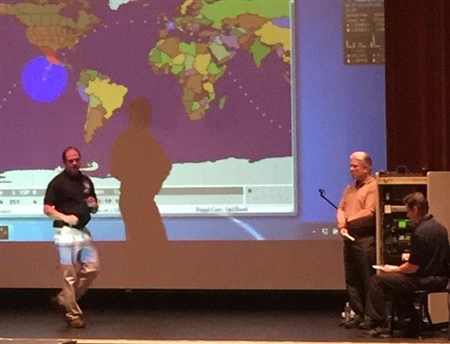 From there, the hard work began. The team bought 400 feet of cable with the connections and spent endless hours at the school installing the antennas (70 feet above the ground on the roof of the auditorium), laying cable, testing equipment and software and constantly problem solving.
“By the time we finished building, we had a little mission control just like in Houston, Texas,” Joe said with a smile.
The team worked out the last few bugs the day before the big event. As the students filed into the auditorium, a map displayed on the screen showing an X for the exact location of the ISS, with a small circle around it denoting the area in which the high school could communicate with the astronauts on board. Over the course of the next 30 minutes, the X traveled across the entire United States, and soon the outer edge of the communications circle hit the high school.
Less than 10 minutes and eight student questions later, the voice of the astronauts faded away, replaced by the static of their transmission.
“The neatest thing is providing kids with opportunities like this, real world moments exposing them to what it is like to be an engineer or to pursue a career in science, technology, engineering or math,” Jerry said. “This is what really inspires a kid – the stuff you just can’t teach in a classroom.”
With the successful connection to the ISS complete, perhaps the most rewarding part of the entire day followed. Students came up to Joe, wearing his TI polo shirt, to ask about his engineering work – and just how in the world (or out of this world) he was able to build, test and successfully run the system that connected them with astronauts flying high overhead.
“We talked about the science, technology, engineering and math, or STEM, making this event possible and how I use it every day in my job at TI,” Joe said. “And I told them if they study STEM subjects, get good grades and push themselves, there is a bright future with great career options.”
It took 150 hours of hard work and effort for just eight minutes of time with the astronauts. But the benefits of this endeavor will last well beyond that short connection.